
A Single Low-Affinity Clone: The Downstream Consequences of Early Reagent Decisions in PK Bioanalysis
Introduction
Rescue projects rarely arrive with a single, obvious point of failure. More often, the root cause traces back to an early decision that seemed reasonable at the time, one that compounds through development and validation and produces failures that become increasingly difficult to resolve. In this case, a PK assay had been developed for a human IgG1 therapeutic antibody entering Phase 1. Sample analysis runs were failing, the resulting data could not be reconciled, and by the time the program reached Immunologix, the stakes were significant: investor deliverables were delayed, a planned FDA interaction was approaching, and the path forward required understanding not only what had gone wrong but also why.
The answer, as it often is in large-molecule bioanalysis, began with the critical reagents.
How Does a Single Reagent Decision Shape an Entire PK Program?
The challenges in this program stemmed from insufficient expertise in managing the anti-idiotypic antibody campaign. A limited screening process yielded a handful of clones, and a single low-affinity clone was chosen for assay development and formatted with the same human Fc isotype as the therapeutic antibody. That decision, while perhaps not immediately recognized as consequential, created a structural constraint: a commercial Fc-specific detection reagent could not be used, as the shared human Fc isotype between the anti-id and the therapeutic eliminated that option. The assay was therefore designed around the single anti-id serving as both capture and detection reagent, resulting in a multistep capture-elute-detect format. The standard curve design that followed did not meet ICH M10 Bioanalytical Guidance requirements, and repeated failures in sample analysis were the result.
This case illustrates a pattern well recognized in bioanalytical science: critical reagent decisions made early in a program set the boundaries within which everything downstream must operate. When those boundaries are too narrow, the assay has limited room to perform.
Why Do Critical Reagents Define Whether a PK Assay Succeeds or Fails?
In ligand-binding assays for therapeutic antibodies, critical reagents are not peripheral to assay performance; they determine it. The specificity, sensitivity, and measurable range of a PK method are direct functions of the reagent selected, their format, and how they are labeled. A well-designed reagent strategy creates flexibility; a constrained one propagates limitations through every subsequent step of development, validation, and sample analysis.
Anti-idiotypic antibodies are the most common critical reagents in PK assays at Immunologix because they bind specifically to the antigen-binding region of the therapeutic drug itself, rather than to a shared structural element like the Fc region. A well-characterized anti-id can distinguish between free and total drug, anchor the assay’s dynamic range, and deliver the signal-to-noise ratio required for reliable quantitation across a broad concentration range. At the same time, the same specificity that makes anti-ids valuable also makes their selection and characterization consequential: affinity, Fc format and species, and binding site all carry forward into assay architecture in ways that can be difficult to reverse once development is underway.
This is why anti-id screening at Immunologix follows a checkerboard approach, evaluating capture and detection reagents in combination rather than in isolation. Performance at the pairing level is what determines assay behavior, and differences between pairings can shift the measurable range by an order of magnitude or more. Selecting reagents without evaluating how they function together leaves a critical variable uncharacterized before development begins.
What Does a Systematic Reagent Rescue Actually Look Like?
Rather than attempting to work around the existing reagent constraints, Immunologix identified the single anti-id as the key point of weakness and returned directly to the original campaign data. The evaluation covered affinity characterization including on-rates and off-rates, Fc isotype compatibility, and the suitability of each clone for capture-only versus capture-and-detect formats. That review identified two additional clones for evaluation, and all anti-ids were reformatted from human Fc to mouse Fc.
The significance of that reformatting decision is worth noting. Switching to mouse Fc restored access to standard commercial anti-human Fc detection reagents, which in turn made a broader set of validated assay architectures available. The isotype compatibility issue that had necessitated the single-reagent design was resolved, and with it, the need for the multistep capture-elute-detect format that had been at the center of the program’s difficulties.
With the reagent strategy on firmer ground, the team developed and validated a new PK assay format that improved sensitivity and increased the dynamic range by 35-fold over the original method. Sample analysis began within three months of the new reagents’ arrival.
What Is the Real Cost of a Constrained Reagent Strategy?
The program consequences of the original reagent approach extended beyond the scientific challenges. Across PK assay development and validation, and PK assay sample analysis, the total cost of the rescue was approximately 2.3 times what the program would have required had the reagent strategy been established correctly from the outset. That figure reflects not only the direct cost of rework but also the compounding effect of repeated sample analysis failures, program delays, and the resource investment required to transfer and re-execute the work.
The figure below breaks down that multiplier by service category and places it alongside the technical outcomes the rescue delivered. The two belong together: the cost comparison is most meaningful when read alongside what a well-executed reagent strategy ultimately made possible.
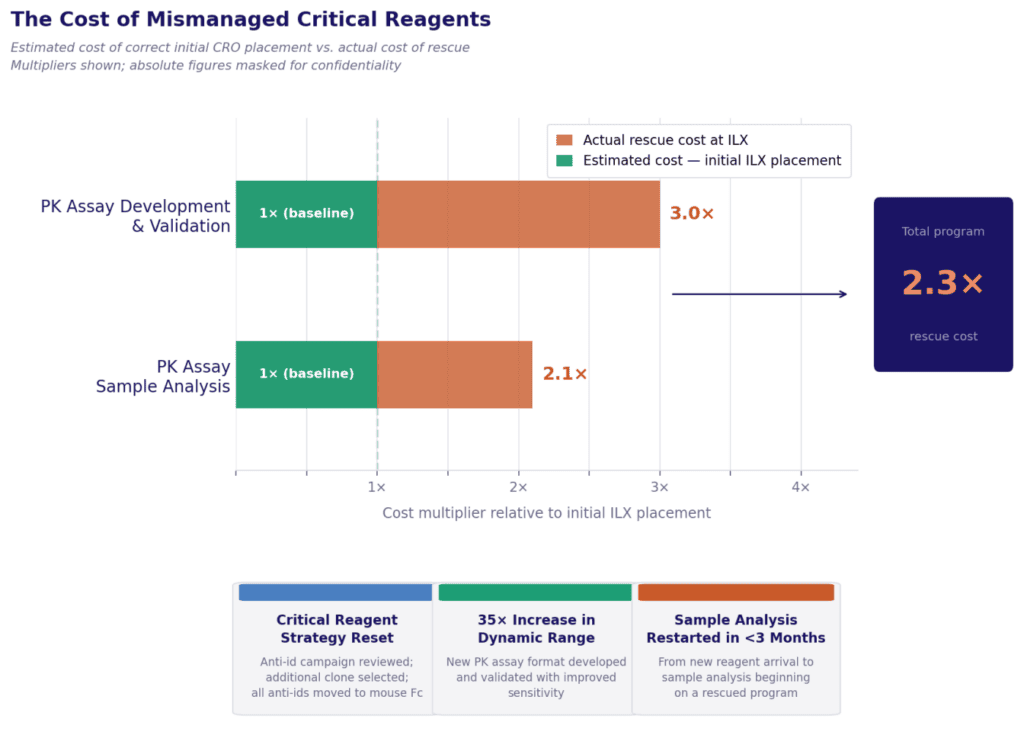
The development and validation multiplier of 3.0× reflects the full scope of reagent rework: revisiting the anti-id campaign, selecting and characterizing an additional clone, reformatting all reagents, and developing and validating a new assay from the ground up. The sample analysis multiplier of 2.1× reflects the cumulative cost of repeated failed analyses before transfer and the additional execution required once the reagent foundation was in place. Both figures represent costs that a more rigorous upstream process would have avoided.
What Questions Should Be Asked Before a PK Assay Program Begins?
Immunologix Laboratories’ program-intake questions are designed to surface these variables before they become constraints. Is the anti-id a Type 1 or Type 2? A Type 1 anti-id is paratope-specific and measures only free or unbound drug, whereas a Type 2 anti-id binds outside the paratope and detects total drug regardless of target engagement status. That distinction shapes the biological interpretation of every PK data point generated by the assay and determines which reagent characteristics matter most during screening.
What Fc isotype does the therapeutic have? Are sponsor-provided reagents characterized for bioanalytical use, or will that characterization need to be part of the development scope? For programs requiring custom anti-id generation, the immunization, screening, and characterization process typically takes six months or more, and understanding that timeline at the outset is essential to keeping development on track. These variables determine whether a program builds on a solid reagent foundation or inherits constraints that will require resolution later.
Why Does Upstream Scientific Rigor Determine Downstream Program Success?
Ultimately, what this program required was not a novel solution. It required a return to the systematic evaluation of reagent options that should anchor any PK assay development effort: characterize what exists, identify what is missing, reestablish the right format, and build from there. That process, applied at the beginning of a program rather than in response to a problem, is what enables development, validation, and sample analysis to proceed with confidence.
Critical reagent planning is not a preliminary step that precedes the real work. It is the foundation on which everything else depends, and the quality of that foundation determines how much flexibility the program retains when conditions change, as they inevitably do in Phase 1 and beyond.